Have a query or want to arrange for sales assistance?
Contact us now by filling out the form or drop us an email. And we’ll get back to you as soon as possible.
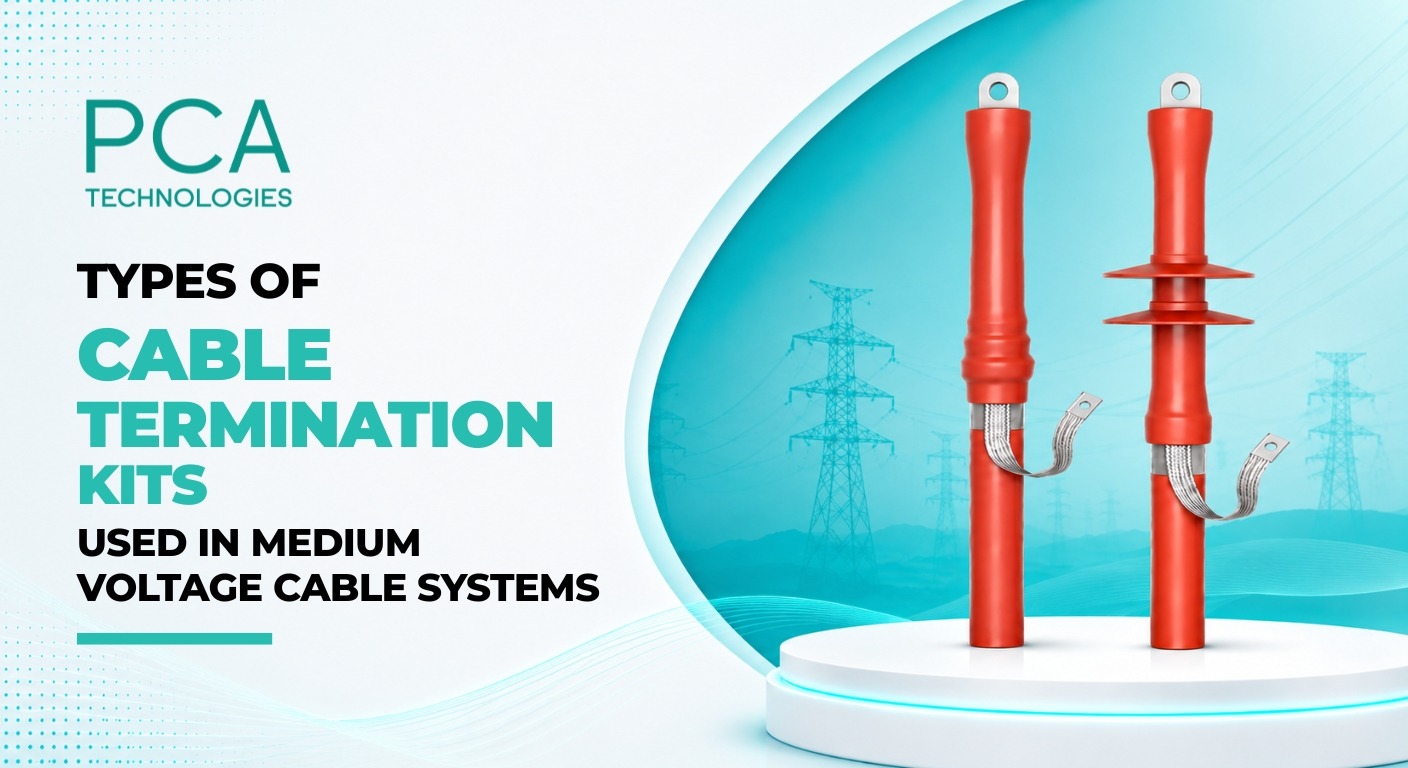
Every medium voltage cable must end somewhere. That endpoint is where a cable termination kit does its job. It seals the cable end, controls electrical stress, and provides a safe interface to equipment like transformers, switchgear, and control panels.
In medium voltage cable systems, which operate between 1 kV and 36 kV, choosing the right cable termination is not optional. A wrong choice can cause insulation failure, flashover, or complete system downtime. Engineers, contractors, and maintenance teams all need a clear understanding of what types are available and what each one is designed to do.
This blog breaks down the main types of cable termination kits used in MV systems and explains how each one is applied in real installations.
A cable termination kit is a set of components used to prepare and finish the end of a power cable for connection to electrical equipment. It typically includes materials for insulation, stress control, sealing, and conductor connection.
In medium voltage systems, these kits must manage the electrical stress that builds up at the point where the cable insulation ends. Without proper stress management at this point, the electric field concentrates and causes dielectric breakdown over time.
A proper power cable termination kit addresses three main functions: it seals the cable end against moisture and contaminants, it controls the electric field at the insulation cutback point, and it provides a secure, low-resistance connection to the terminal.
Heat shrink terminations are among the most widely used in MV applications. They use polymer tubing that shrinks tightly around the cable when heat is applied using a torch or hot air gun. The process bonds the tubing to the cable surface, creating a moisture-resistant and electrically stable seal.
Stress control: A stress control tube is applied over the insulation screen cutback point to redistribute the electric field.
Suitable for: Indoor and outdoor applications. Outdoor kits include weather sheds for added protection against rain and UV exposure.
Common use: Substations, industrial switchgear, motor connections in manufacturing plants.
Heat shrink kits are popular because they are easy to install and available for a wide range of cable sizes and voltage ratings. They require basic skills and the right heat source for proper installation.
Cold shrink terminations are pre-expanded onto a plastic core during manufacturing. The installer removes the core on site, and the elastomeric material contracts firmly around the cable without any heat source.
Key advantage: Faster installation in environments where open flame is not permitted, such as oil refineries, chemical plants, or food processing facilities.
Material: Typically made from silicone or EPDM rubber, both of which offer excellent resistance to weathering, UV, and temperature variation.
Suitable for: Indoor and outdoor installations. Outdoor cold shrink kits include integral rain sheds.
The cold-shrink MV cable termination kit is slightly more expensive than the heat-shrink version but offers advantages where speed and safety are the priority.
These terminations come factory-moulded to precise dimensions. They are slid directly onto the prepared cable end and locked in place. No heat or tools are needed for the installation of the body itself.
Design: The termination body includes integrated stress cones and insulation. It is made from silicone rubber or EPDM.
Accuracy: Factory moulding ensures consistent dimensions, which reduces installation error.
Suitable for: High-reliability installations where precision is critical, including wind farms, railways, and critical power infrastructure.
Pre-moulded terminations are favoured in new projects with standard cable types because they reduce installation time and eliminate variability caused by on-site workmanship.
Separable connectors, sometimes called elbow connectors or T-connectors, are modular terminations used primarily in switchgear and transformer connections. They allow the cable to be connected and disconnected without de-energising the full system in some configurations.
Touch-safe design: These connectors are shrouded to prevent accidental contact with live parts.
Modular use: Can be used with load-break or dead-break ratings depending on the system requirement.
Suitable for: Ring main units, pad-mounted transformers, cable distribution boxes.
Separable connectors are increasingly standard in modern distribution networks because they simplify switchgear maintenance and cable replacement work.
One of the first decisions when selecting a cable termination kit is whether it will be used indoors or outdoors.
Indoor terminations are designed for protected environments like switchgear rooms or cable cellars. They are compact and do not include weather sheds. The focus is on electrical performance and ease of installation in confined spaces.
Outdoor terminations must withstand rain, UV radiation, pollution, and temperature swings. They include weather sheds or silicone rain sheds that increase the creepage distance and prevent tracking along the surface.
Applying an indoor termination in an outdoor location is a common installation error that leads to premature failure. Always check the kit rating before installation.
Selecting the right kit depends on several factors:
When in doubt, consult the cable manufacturer’s documentation and match it to a certified termination kit from a reputable supplier.
Cable termination is a small but critical part of medium voltage systems. The right power cable termination kit ensures safety, reliability, and long-term performance.
From heat-shrink to separable connector kits, each type has its own advantages. Understanding these options helps in making informed decisions for different applications.
Whether it is an industrial plant or a rural irrigation system, proper cable termination plays a vital role in an uninterrupted power supply.
For a complete range of cable termination products suited to medium voltage applications, visit PCA Technologies.
A cable termination kit is used to safely connect power cables to electrical equipment while maintaining insulation and protection.
Heat shrinks, and cold shrink kits are commonly used for outdoor conditions due to their resistance to weather and moisture.
Heat shrink kits require heating to shrink around the cable, while cold shrink kits shrink automatically without heat.
Yes, they are widely used in irrigation systems, pumps, and farm equipment to ensure a reliable power supply.
Proper termination prevents electrical faults, improves safety, and increases the lifespan of the cable system.
Contact us now by filling out the form or drop us an email. And we’ll get back to you as soon as possible.
© PCA Technologies Private Limited – 2026