
Have a query or want to arrange for sales assistance?
Contact us now by filling out the form or drop us an email. And we’ll get back to you as soon as possible.
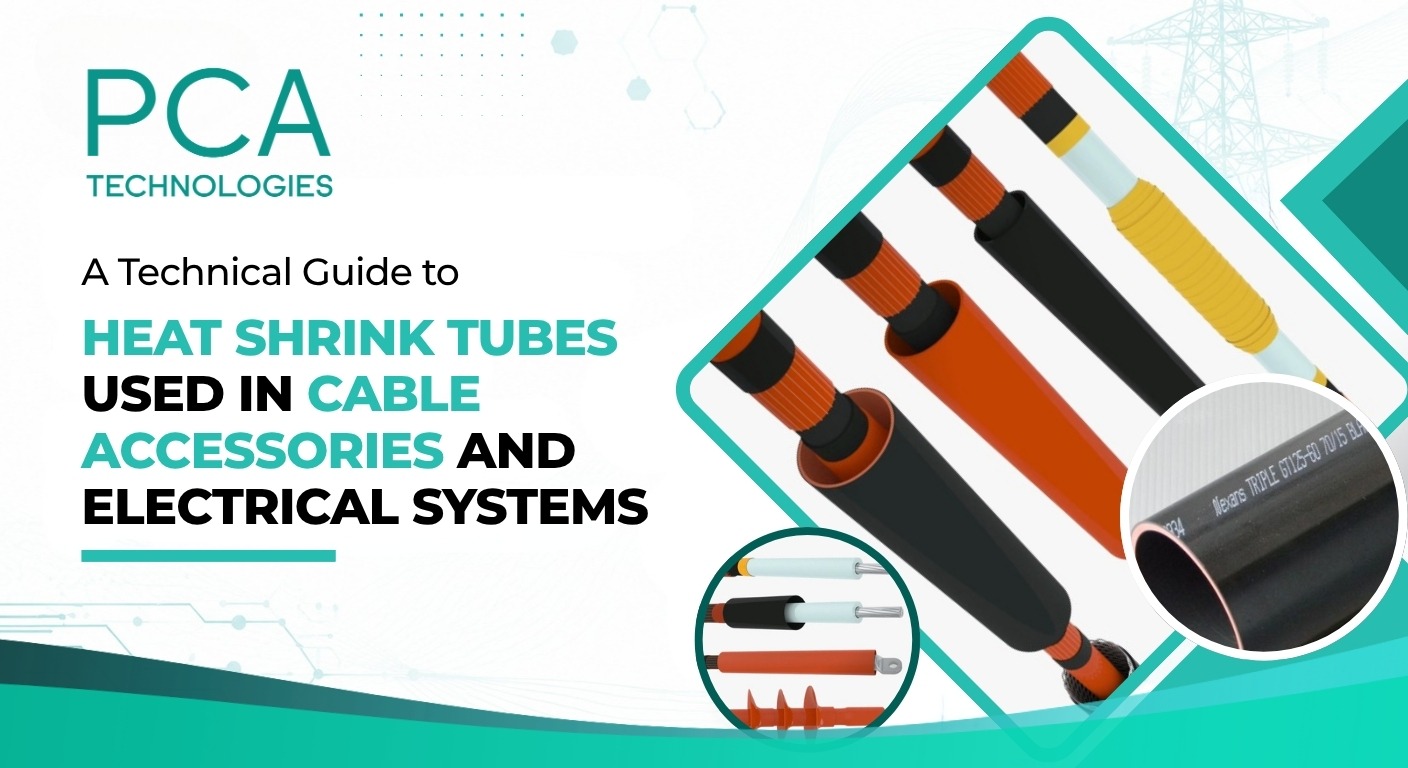
Heat-shrink technology is used in electrical cable accessories to restore insulation, control electrical stress, seal against moisture, and protect cable connections. A heat shrink tube has molecular memory. When heated, it recovers toward its original size and fits closely around the cable or connector.
Thermoplastic polymers contain long molecular chains arranged around crystalline regions. When ordinary thermoplastic material is heated above its melting range, the chains gain mobility, and the material may soften or flow.
Heat-shrink material behaves differently because its polymer chains are permanently joined through crosslinking. This creates a stable three-dimensional network.
During manufacturing, the polymer is exposed to a controlled cross-linking process, often using a high-energy electron beam. Permanent bonds form between adjacent molecular chains, allowing flexibility when heated without uncontrolled flow.
The tube is heated and expanded to a larger diameter. It is then cooled while held in that position, allowing crystalline regions to reform and lock it in its supplied size.
During installation, controlled heat melts these temporary crystalline locks. The elastic cross-linked network pulls the tube toward its original diameter. After cooling, the crystalline regions reform and secure the tube around the cable accessory. This process is known as shape memory.
Uniform recovery creates radial pressure around cable insulation, screen cutbacks, connectors, mastics, and outer sheaths. This improves contact and allows sealants to fill minor surface irregularities.
The recovered tube provides insulation coverage and environmental sealing around a Heat Shrink Termination or cable joint kit. This is important in MV Cable Joints and HV cable jointing, where incomplete recovery may allow moisture entry.
A cable termination kit must restore the electrical and mechanical functions of the original cable system.
Stress control tubing and mastic redistribute the electric field near the cable screen cutback. High dielectric tubing rebuilds insulation. Semiconductive layers reconstruct the cable screen and support electrical field control.
Metallic screen continuity is restored separately using copper wires, Insulated Copper Braid, or another suitable earthing component. This distinction is important because semiconductive materials and metallic earthing components perform different functions.
Anti-tracking materials reduce surface leakage. Adhesive-lined outer tubes protect the completed connection against moisture, abrasion, dust, and contaminants.
Correct installation remains essential. Overheating can damage the polymer, while insufficient heating may leave wrinkles or incomplete sealing. Installers should follow the specified cable preparation dimensions, heating sequence, and recovery indicators.
PCA Technologies offers heat shrink accessories for LV, MV, and HV power networks. The range includes Nexans JTS Heat Shrink Joints, Nexans Mono Heat Shrink Terminations, TTGI3 indoor terminations, TTGE3 outdoor terminations, and supporting insulation products.
Nexans JTS Heat Shrink Straight Through Joints connect polymeric cables in MV distribution systems. Their main advantage is the integration of several electrical functions into fewer components.
For applications up to 24 kV, the TRIPLE GT125 tube combines stress control, insulation, and conductive functions. Higher voltage designs up to 42 kV use integrated coextruded layers.
Orange mastic supports electrical field grading around the Shear Bolt Connector and semiconductor screen area. An adhesive-lined outer tube restores environmental protection around the completed joint.
This integrated arrangement reduces internal interfaces and lowers the possibility of positioning errors during installation.
Nexans Mono Heat Shrink Terminations provide compact indoor and outdoor cable termination solutions.
The MONOi Heat Shrink Indoor Termination uses an integrated tube with an inner stress control layer and an outer anti-tracking layer. Its compact design is suitable for Switchgear Cable Termination, transformer cable termination, and restricted cable box spaces.
The MONOe Heat Shrink Outdoor Termination is designed for exposed service. It combines stress control, sealing, anti-tracking protection, and compatibility with mechanical or crimping lugs.
The TTGI3 Heat Shrink Indoor Termination uses stress control tubing and mastic to manage the electric field around the cable screen cutback. Sealing materials protect the lug area, armour connection, and cable breakout.
The TTGE3 Outdoor Termination Kit uses anti-tracking components and rain sheds to provide the required creepage distance. Outdoor designs generally need stronger resistance to moisture, sunlight, pollution, and surface tracking.
Rain sheds should not be treated as the only difference between indoor and outdoor designs. Some higher voltage indoor terminations may also use components that increase creepage distance.
Self-Amalgamating Tape, HT EPR Tape, and High Voltage Tape
Self-Amalgamating Tape fuses into a continuous mass when stretched and wrapped correctly. It is used for insulation, sealing, padding, and weather protection around cables and irregularly shaped electrical components.
Insulating HT EPR Tape supports insulation rebuilding and moisture sealing. Conductive EPR tape is used to smooth electrical stress around lugs, connectors, and cable screen transitions.
Silicone High Voltage High Temperature Tape is selected where thermal resistance, flame retardancy, ultraviolet resistance, weather protection, and dependable electrical insulation are required.
Busbar Heat Shrink Sleeve and Overhead Line Cover
A Busbar Heat Shrink Sleeve improves insulation around exposed busbars and reduces the risk of accidental electrical contact.
An Overhead Line Cover provides additional protection around conductors in locations where wildlife interference, vegetation contact, or accidental contact may occur.
Heat shrink technology converts polymer shape memory into a controlled installation method for power cable accessories. Its performance depends on effective cross-linking, uniform recovery, electrical stress control, correct cable preparation, and reliable environmental sealing.
The correct product must match the cable construction, voltage class, conductor size, connector type, equipment interface, and service environment. PCA Technologies supports these requirements through Nexans JTS joints, MONO terminations, TTGI3 and TTGE3 kits, and related heat shrink and insulation products.
Crosslinking creates permanent bonds between the polymer chains. After the tube is expanded and cooled, reheating allows the elastic molecular network to pull it toward its original dimensions.
Uneven heating may cause wrinkles, local damage, trapped air, or incomplete recovery. Heat must be applied evenly around the tube according to the installation instructions.
Indoor Termination Kits are designed mainly for protected environments. An Outdoor Termination Kit requires stronger weather sealing, anti-tracking protection, and suitable creepage distance for exposed conditions.
Stretch the tape and wrap it around the component using overlapping layers. The layers fuse to form a continuous seal without requiring a separate adhesive.
The cable screen cutback can create a concentration of electrical stress. Stress control tubing and mastic redistribute the electric field and reduce the risk of partial discharge or insulation damage.
Contact us now by filling out the form or drop us an email. And we’ll get back to you as soon as possible.
© PCA Technologies Private Limited – 2026